
What Gets Lost in Translation Is Evidence
A translated answer is not the same answer. How language access shapes research data and how Shama supports multilingual fieldwork in Ethiopia.
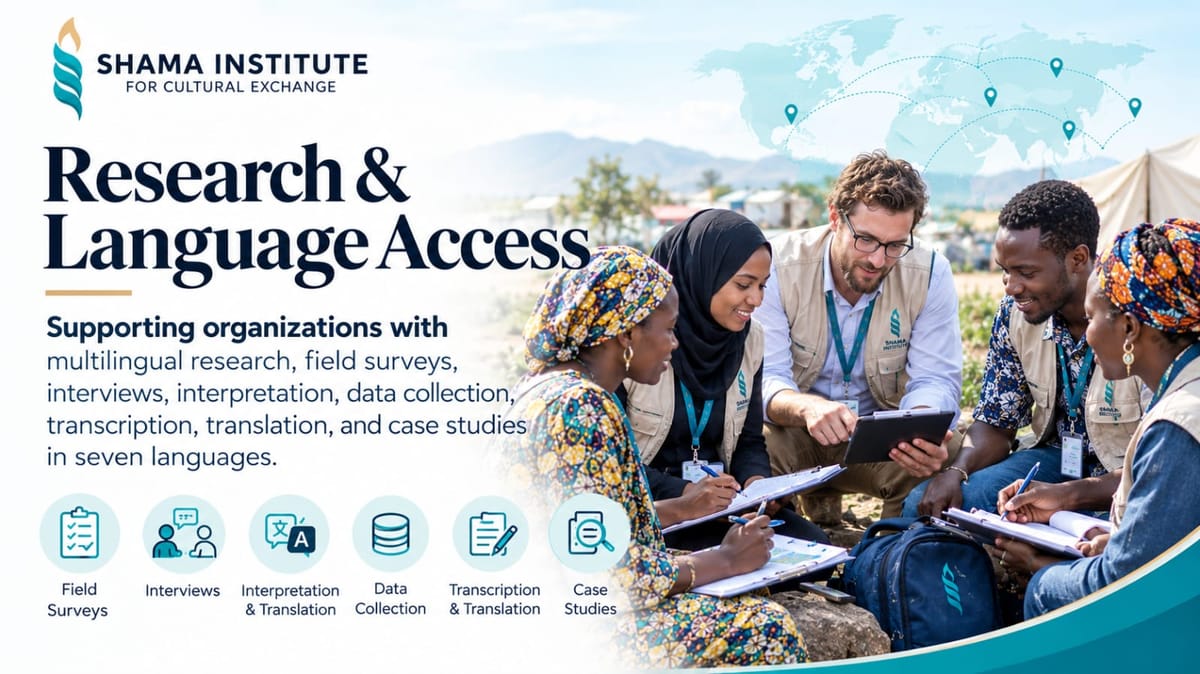
Research is only as good as what participants were able to say, and what the team was able to hear. Language access is not a courtesy at the end of the process. It decides the quality of the data you end up analyzing.
A translated answer is not the same answer
Nuance, hesitation, and idiom are where meaning lives. When they are lost in the room, no amount of careful analysis afterwards puts them back.
Participants say more in their own language
People interviewed through a barrier tend to give shorter, flatter, more guarded answers. Removing the barrier changes what you are able to hear.
Local knowledge is a research input
Who to approach, how to ask, when to come back. Field staff who know the community produce data that a visiting team cannot.
What Shama provides
Shama is a refugee-led social enterprise in Addis Ababa. Our Research & Language Access service brings together interviewers, interpreters, transcribers, translators, field staff and documentation specialists, working in seven languages: Arabic, Amharic, Tigrinya, Somali, Swahili, French and English. Other languages can be mobilized through our professional network for selected assignments, subject to availability.
- Multilingual interviews: conducted directly in the participant's language, or with a professional interpreter supporting your own researcher.
- Transcription and translation: multilingual audio, video, and research materials turned into accurate, usable content.
- Field research support: practical local support for research assignments in Ethiopia.
- Case study support: program results, experiences and community perspectives captured as credible case-study and impact-story content.
- Visual documentation: photography, video, interviews and field documentation.
Our work is human-led and quality-assured, and it is ethical, confidential and safeguarding-focused.
Two ways to run an interview
Either a Shama interviewer conducts the interview in the participant's language, or a Shama interpreter makes your own researcher's conversation possible. Not sure which fits? Read this article to decide.
How it works
- Tell us about the assignment. Send the brief or ToR, or just describe it. Languages, participants, location, and deadline are enough to start.
- We scope it with you. Within two working days, we come back with the approach, the team we would put on it, and what it costs.
- We assemble the team. Interviewers, interpreters, transcribers, field staff, and documentation, drawn to fit the assignment rather than a fixed package.
- Delivery, with the work checked. Transcripts, translations, case studies, or visual material, quality-assured before they reach you.
Have an assignment in Ethiopia? Tell us about your project via the form, or write to shama.cultural@gmail.com. We reply within two working days.